
Watching someone you love struggle with depression can feel overwhelming, especially when you’re not sure what to say or do. You want to help, but you don’t want to make things worse. You may feel helpless, frustrated, or even frightened at times, and those feelings are completely understandable. The good news is that your support genuinely matters.Â
Research consistently shows that social support, especially from close family members, is associated with lower levels of depression and improved recovery outcomes. Studies have found that strong support systems can reduce loneliness, buffer stress, and improve overall mental health functioning. This article offers seven practical, evidence-informed tips for how to help a family member with depression, along with guidance on protecting your own well-being in the process.
Quick Takeaways
- Depression is a medical condition, not a personal flaw or a choice; approaching it with that understanding changes how you show up.
- Listening without trying to fix is often more helpful than offering advice or solutions.
- Practical support, like helping with household chores or attending therapy appointments, can reduce barriers to treatment.
- Knowing the signs of suicide risk and having crisis resources available is an important part of supporting someone with severe depression.
What Depression Actually Looks Like in a Family Member

Before getting into how to help, it’s worth taking a moment to recognize what depression symptoms can look like from the outside, because they don’t always match what people expect.
Major depressive disorder can show up as:
- Persistent low mood or sadness that doesn’t lift
- Withdrawal from activities and relationships they used to enjoy
- Fatigue and difficulty getting out of bed or completing normal activities
- Irritability or emotional flatness, not just visible sadness
- Changes in appetite, leading to weight loss or weight gain
- Physical aches, sleep disturbances, and difficulty concentrating
- Expressions of hopelessness, worthlessness, or past failures
Depression affects each person differently, and someone with clinical depression may not always look visibly distressed. Sometimes it looks like someone who has quietly stopped engaging with life.
Tip 1: Learn What You’re Actually Dealing With

One of the most helpful things you can do before anything else is learn about depression diagnosis and what major depressive disorder actually involves. When you understand that depression is a medical condition with biological, psychological, and social components, rather than laziness, weakness, or a choice, it shifts how you respond. It also helps to understand that depression often presents differently in women than in men, which can affect how you recognize and respond to symptoms in a female family member.
It can reduce the frustration of wondering why your loved one can’t “just snap out of it,” and it helps you respond with more patience and less unintentional pressure.
A few reliable places to learn:
- The National Institute of Mental Health (NIDA)
- The National Alliance on Mental Illness (NAMI)
- The Substance Abuse and Mental Health Services Administration (SAMHSA)
What to Avoid Saying
Even with good intentions, certain phrases can make someone with depression feel worse:
- “You have so much to be grateful for”
- “Other people have it worse”
- “You just need to push through it”
- “Have you tried exercising more?”
These responses, however well-meaning, can reinforce feelings of shame and make it less likely your loved one will open up to you.
Common Depression Symptoms and How They May Appear to Family Members
Depression can show up differently than people expect. Recognizing these patterns at home makes it easier to respond in ways that actually help.
| Symptom Category | How It May Look at Home | Common Misinterpretation | More Helpful Response |
| Low mood/sadness | Crying, emotional flatness, irritability | “They’re being dramatic” | Acknowledge feelings without minimizing |
| Fatigue | Sleeping excessively, difficulty starting tasks | “They’re being lazy” | Offer specific help with certain tasks |
| Withdrawal | Canceling plans, staying in their room | “They don’t want to be around us” | Check in gently without pressure |
| Physical aches | Frequent complaints of headaches, body pain | “It’s not real” | Validate that physical problems are real symptoms |
Tip 2: Listen More Than You Speak
When someone is in a depressive episode, they often don’t need solutions; they need to feel heard. One of the most powerful things you can offer is simply your presence and your attention.
Listen carefully without interrupting. Reflect back what you hear. Resist the urge to immediately offer practical advice or suggest seeking professional help in the same breath as listening; there’s a time for that, but it shouldn’t crowd out the act of being present.
Creating a safe space where your family member feels they can talk without being judged or redirected is something only you, as someone close to them, can really provide. That kind of emotional safety can make it easier for them to eventually accept support, including professional help.
Tip 3: Offer Specific, Practical Support
When someone is dealing with severe depression, the cognitive load of daily life can feel enormous. Asking “let me know if you need anything” is kind, but it puts the burden of asking back on the person who is already struggling.
More helpful is offering specific tasks:
- “I’m going to the grocery store, can I pick up a few things for you?”
- “I’d like to come over and help organize household chores on Saturday”
- “I can drive you to your therapy appointments this week if that would help”
Suggest specific tasks rather than open-ended offers. Small, concrete gestures, helping with healthy meals, handling logistics, or simply sitting with someone, reduce the friction that can keep someone from taking care of themselves during a difficult period.
Tip 4: Gently Encourage Professional Help
You can’t treat someone’s depression for them, and trying to become their therapist is likely to exhaust you both. A good starting point can be suggesting a validated screening tool like the Beck Depression Inventory, which can help open the conversation about seeking professional care. What you can do is gently and consistently encourage them to seek professional help, and make that step feel less daunting.
Some people resist mental health services because of stigma, fear, or the sheer effort it takes to start.
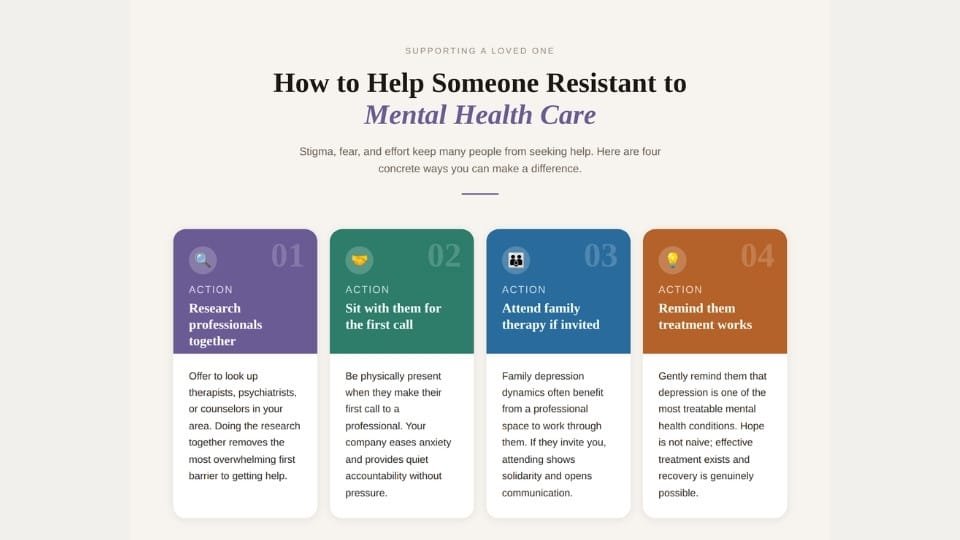
If your loved one is already in treatment, supporting them in taking prescribed medications and attending appointments is a practical way to reinforce the professional help they’re already receiving. While treatment is effective, finding the right combination of therapy and/or medication can sometimes take time and trial-and-error.
Tip 5: Know the Warning Signs of Suicide Risk
This is the tip many people are most reluctant to think about, but it may be the most important one.
Depression carries an increased risk of suicidal thoughts, and knowing how to recognize warning signs can save a life. Signs that someone may be at higher risk include:
- Talking about wanting to die or expressing that others would be better off without them
- Giving away possessions or saying goodbye in unusual ways
- A sudden calm after a period of severe depression, this can sometimes indicate a decision has been made
- Talking about suicide attempts or past failures in a way that sounds final
- Increased substance abuse alongside depressive symptoms
If you’re concerned about suicide risk, ask directly. Research consistently shows that asking someone if they’re thinking about suicide does not plant the idea; it opens a door.
If someone is in immediate danger, call 988 (the Suicide and Crisis Lifeline) or go to the nearest emergency room. You can also call or text 988 yourself if you need guidance on how to support someone you’re worried about.
Tip 6: Protect Your Own Well-being
Supporting a family member with depression is genuinely hard, and it can take a toll on your own mental health if you’re not paying attention to it.
Your own well-being matters, not just for your sake, but because you can’t support someone else sustainably if you’re depleted. A few things that may help:
- Set realistic expectations for what you can offer
- Maintain your own routines, relationships, and activities
- Consider attending support groups for families of people with mental illness. The National Alliance on Mental Illness offers family support programs
- Talk to a mental health professional yourself if you’re finding it hard to cope
- Recognize that you cannot force recovery, and that your loved one’s progress is not a measure of how much you care
Caregiver burnout is real, and it can happen gradually. Checking in with your own mental health isn’t a distraction from helping; it’s part of how you help for the long term.
Tip 7: Stay in It for the Long-Term
Recovery from major depression is rarely linear. There may be periods of real improvement followed by a depressive episode that feels like starting over. This is normal, and it doesn’t mean treatment isn’t working.
Staying connected, even when your loved one pushes back, withdraws, or seems unreachable, communicates something that words alone can’t: that they are worth showing up for, consistently, over time. Offer hope without pressuring them. Share positive qualities you genuinely see in them. Keep inviting, even if they often say no. The cumulative effect of consistent, patient presence is something that matters more than any single conversation.
How to Support Someone at Different Stages of Treatment
Your role shifts depending on where your loved one is in the process. This breakdown can help you show up in the right way. No single stage looks the same for every person, so staying flexible matters. Small, consistent actions often carry more weight than grand gestures at any point in treatment.
| Stage | What Your Loved One May Need | How You Can Help | What to Avoid |
| Not yet in treatment | Encouragement, reduced barriers | Help research providers, offer to accompany them | Ultimatums, pressure, frustration |
| Starting treatment | Consistency, patience | Attend family therapy sessions if invited, help with logistics | Expecting immediate change |
| In active treatment | Stability, practical support | Help with household chores, healthy meals, transportation | Taking over their responsibilities entirely |
| Recovery/maintenance | Normalcy, continued connection | Stay engaged, celebrate small progress | Assuming they’re “fixed” and withdrawing support |
Frequently Asked Questions About How to Help a Family Member With Depression or Anxiety
How do I talk to a family member about their depression without making things worse?
Choose a calm, private moment and lead with care rather than concern. Phrases like “I’ve noticed you seem to be going through something difficult, and I want you to know I’m here” tend to land better than leading with worry or advice. Listen carefully and avoid jumping to solutions; your presence matters more than having the right words.
What if my family member refuses to get help for their depression?
You can’t force someone into mental health treatment, but you can keep the door open. Continue offering support, avoid enabling behaviors that might make it easier to avoid getting help, and consider attending family therapy yourself to get guidance on how to navigate the situation. The National Alliance on Mental Illness offers resources specifically for families in this position.
How do I know if my loved one’s mental health condition is serious enough to be concerned about suicide?
Any mention of suicidal thoughts deserves to be taken seriously, even if it seems casual or indirect. Direct statements about wanting to die, expressions that others would be better off without them, or sudden calm after severe depression are all signs to pay attention to. When in doubt, ask directly and contact the 988 Suicide and Crisis Lifeline for guidance.
You Don’t Have to Have All the Answers
Supporting a family member through depression doesn’t require you to be a mental health professional. It requires you to show up, listen, offer what you practically can, and take care of yourself along the way. That combination, sustained, patient, informed support, is something that genuinely makes a difference.
At Kinder in the Keys, we work with individuals and families navigating depression and anxiety, and we know how much the people around someone in treatment matter. If your family is looking for support, whether for your loved one or for yourself, we’d welcome the conversation. Reach out to learn more about how we can help.